Porcelain Pavers Perth

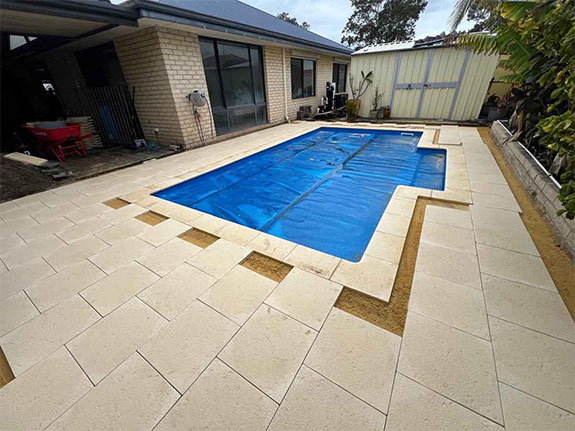
Porcelain has quietly taken over as the material people ask us about for pool surrounds and alfresco areas, and there’s a straightforward reason for it. It doesn’t need sealing, it doesn’t fade, and pool chemicals and sunscreen sit on top of it rather than soaking in.

The catch is that “porcelain” covers an enormous range of products, and the ones that photograph best in a showroom are often the worst choice for an uncovered Perth courtyard. Format, finish, slip rating and colour all change how the finished area performs, and a couple of those decisions are difficult to undo once the pavers are down.

So most of this page is about the decisions rather than the sales pitch. If you’d rather just talk it through, the number’s at the bottom.

Free on-site porcelain paving quotes across Perth’s western and northern suburbs.

What porcelain paving actually is

Porcelain is a clay-based ceramic fired at very high temperature until the body vitrifies, meaning it fuses into something close to glass. The result is dense, hard and effectively non-porous. Under the tile classification standards, a true porcelain has a water absorption rate of half a per cent or less, which is why it doesn’t need sealing and why liquids don’t penetrate it.

That absorption figure is worth knowing, because “porcelain” gets used loosely in retail. If a product’s absorption rate isn’t stated, it’s worth asking.

For outdoor use, porcelain is made much thicker than the wall and floor tiles you’d use inside. 20mm is the standard outdoor thickness and it’s what we work with for paving. Thicker formats exist for specific applications.

Most outdoor porcelain is also rectified, meaning the edges are mechanically ground after firing so every tile is dimensionally identical. That’s what allows the narrow, consistent joints you see in contemporary paving. It also means there’s nowhere to hide: with rectified tiles, any variation in the base or the laying shows up immediately.

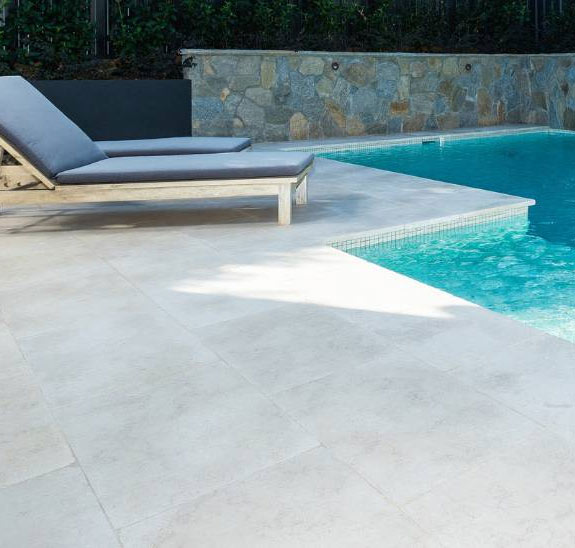
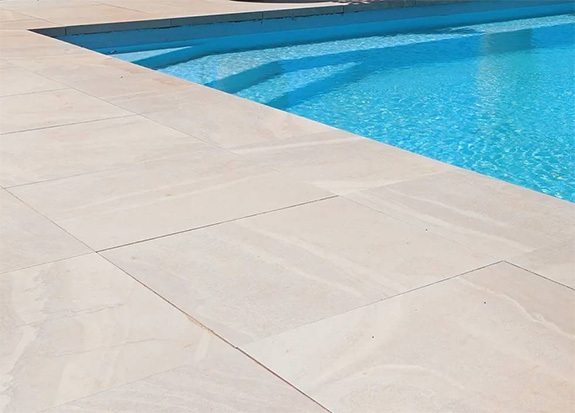
One genuine advantage over natural stone is the range of looks. Concrete-look, stone-look, timber-look and marble-look finishes are all available, which gives you far more scope to match a paved area to an existing house or garden.

Finish and format

Matt and textured finishes

These are what we specify for outdoor work. They grip properly when wet, they suit pool surrounds and uncovered patios, and they hide grit and minor marks better than smoother surfaces. That last point matters more in Perth than people expect, given how much fine sand ends up on every outdoor surface here.

Polished and semi-polished

They look sharp in a catalogue and they have no business in an uncovered outdoor area. Wet polished porcelain is genuinely slippery, and it’s not a trade-off worth making around a pool or anywhere that catches summer rain. We won’t specify them outdoors.

Format size

Large format, 600x600mm and up, is the popular choice for contemporary spaces. Fewer joints, cleaner and more open-looking surface. Large format is also less forgiving: it needs a flatter base and a properly solid bed underneath, because a big rigid tile spanning a hollow is a tile waiting to crack.

Smaller formats suit garden paths, feature areas, stepped sections and anywhere with curves or tight cuts.

Slip resistance, and which ratings actually apply here Slip resistance, and which ratings actually apply here

Worth spending a minute on, because the numbers most suppliers quote aren’t the ones that count for a pool.

You’ll almost always be shown an R rating, usually R11 or R12. That comes from an oil-wet ramp test carried out by an operator wearing boots. It’s a European convention, it’s genuinely useful for shod walkways and commercial floors, and it tells you comparatively little about a barefoot person on a wet pool concourse.

In Australia, slip resistance is classified under AS 4586. That standard includes a wet pendulum test producing a P rating, and a separate wet barefoot ramp test producing a Class A, B or C result. A pool surround is a barefoot wet area, so the barefoot classification is the relevant one, and SA HB 198 sets out which classification suits which application.

Our approach on any job going near water: we ask the supplier for the AS 4586 test report for that specific product and check the classification against the application, rather than taking an R number at face value. Most suppliers can produce it. The ones who can’t are telling you something.

How porcelain performs in Perth

Pool chemicals and salt air

This is where porcelain earns its money. The non-porous surface means chlorine, salt and sunscreen don’t soak in, so there’s no gradual staining and no degradation of the material the way you’d get with unsealed natural stone. For coastal properties through Trigg, Sorrento and Scarborough where salt exposure is constant, it holds up well.

Sun and colour

Porcelain is UV stable. The colour is fired into the product, so what you choose at installation is what you have in year ten. It won’t bleach or chalk the way some composite and synthetic products do.

Heat underfoot

Here’s where colour choice becomes a practical decision rather than an aesthetic one.

Porcelain is dense, and dense materials conduct heat readily. Light-coloured porcelain in a matt finish is manageable underfoot on a hot day. Dark and charcoal tones absorb far more radiant heat and can become genuinely painful to cross barefoot on a 40 degree February afternoon.

Charcoal porcelain looks superb in photographs. Around an exposed pool in Perth, it’s often a decision people regret by the second summer. For uncovered pool surrounds and open entertaining areas we steer clients towards light and mid tones. Under a covered alfresco, the darker ranges are back on the table.

Ground movement

Perth’s sandy soils move, and porcelain is less tolerant of that than most paving materials. Because rectified tiles are dimensionally precise with narrow joints, even small amounts of settlement show up clearly as lipping between tiles. There’s no natural variation to disguise it.

Which is why more of our effort on a porcelain job goes into what’s underneath than into the laying itself.

How porcelain gets laid, and why the method matters How porcelain gets laid, and why the method matters

Three approaches, and the right one depends on the application. This is the conversation to have before anyone talks about products.

Bonded over a concrete slab

The tiles are adhered to a properly designed concrete slab using a full solid bed of flexible outdoor tile adhesive, with no voids underneath. The most stable method, the flattest result, and the method required for large format work and for anything carrying vehicle loads.

Sand-set over a compacted base

Laid over compacted road base and a bedding layer, in the same way as traditional pavers. More forgiving of minor ground movement, permeable, and generally more economical. Pedestrian areas only, and joint widths tend to be wider.

Pedestal systems

The pavers sit on adjustable pedestals over an existing slab or a waterproofed substrate, creating a drainage void beneath. Good for achieving a level threshold between inside and out, for going over an existing surface without building up the height, and for balconies and roof terraces. Pedestrian only, and the edge detailing needs care.

Our installation process

  1. Free on-site consultation. We look at the space, how it’s used, where the sun falls and what’s already there. We work through format, finish, colour and slip rating with you, and give you a straight view on what suits the application before anything is ordered.
  2. Excavation and site preparation. We excavate to the correct depth for the chosen method and remove existing surfaces, roots and debris. Getting the depth right at this stage is what lets the finished level sit correctly against your house, paths and any existing paving.
  3. Base construction. For a sand-set job, road base laid and compacted in layers with a mechanical plate compactor. For a bonded job, a concrete slab designed for the application. This is the step that decides whether the job still looks right in ten years, and it’s the step most commonly rushed.
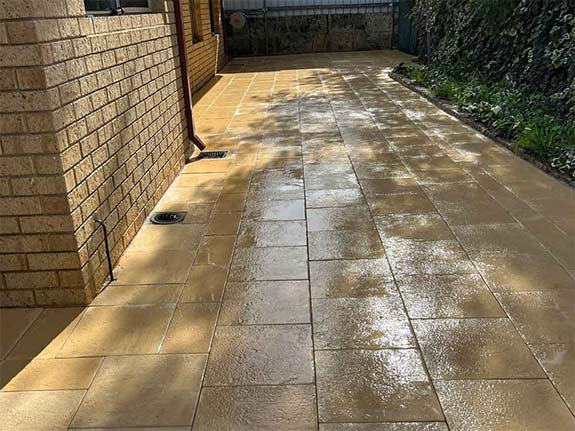
  4. Falls and drainage. All paving is laid to fall away from the building. A minimum of 1:100, which is 10mm of fall per metre, and we generally build in a little more where the situation allows. Water pooling against a wall during a Perth winter is a problem that gets expensive.
  5. Bedding and laying. Bedding sand screeded to level, or a full solid bed of flexible adhesive for bonded work, with back-buttering on large format so there are no hollow spots. Pavers laid to the agreed pattern with consistent joint spacing. Cuts made with a wet saw and a diamond blade for clean edges.
  6. Movement joints. Large rigid tiled areas need somewhere to expand. We install perimeter movement joints where the paving meets walls, columns and other surfaces, and intermediate joints through larger areas, filled with a flexible sealant rather than grout. Spacing follows the tiling standard, typically every four to five metres in exposed external areas, and closer where dark colours and full sun mean higher thermal movement. Leave these out and a large porcelain area will eventually find its own expansion joint, usually through the middle of a tile.
  7. Grouting and clean down. Joints filled with a grout suited to the joint width and the exposure. Around pools, where chemical contact is constant, an epoxy grout is often the better call. Surface cleaned down before handover so no residue is left to haze.
  8. Handover. Site cleaned up, and we walk you through cleaning and care for your specific product before we leave.

Porcelain compared with the alternatives

Porcelain Limestone Travertine Concrete pavers
Sealing None required Needs sealing and resealing Needs sealing and resealing Sealing usually recommended
Stain resistance Very high Low unsealed Low unsealed Moderate
Heat underfoot Depends heavily on colour. Dark tones get very hot Stays noticeably cooler. One of its real strengths Stays cool Varies with colour
Fading None, UV stable Weathers, usually pleasantly Weathers Can fade over time
Pool chemicals and salt Excellent Poor unless well sealed and maintained Poor unless sealed Moderate
Range of looks Very wide, including stone, timber and concrete looks Natural WA character, limited range Natural, warm tones Manufactured range
Base requirements Most demanding. Needs precision More forgiving More forgiving Most forgiving
Upfront cost Higher Mid Mid to higher Lower
Lifetime cost Low, no sealing to pay for Ongoing sealing costs Ongoing sealing costs Low to moderate

Neither material is simply better. Porcelain wins on maintenance, stain resistance and design range. Limestone wins on heat underfoot and natural character, which is why it remains such a common choice around Perth pools. If you’re weighing them up, our limestone paving page covers that side of it.

What porcelain paving costs in Perth What porcelain paving costs in Perth

Fair question, and the honest answer is that porcelain has a wider price range than almost any other paving material, because the product cost alone can vary several times over between ranges.

What moves the number:

  • The product. Entry-level outdoor porcelain and premium European ranges are in very different territory
  • The laying method. A bonded installation needs a concrete slab underneath it, which is a substantially bigger job than a sand-set base
  • What’s coming out first. Bare sand is straightforward. Removing an existing concrete slab or old paving is not
  • Area and shape. Small areas cost more per square metre. Curves, steps, garden bed edges and pool coping all add cutting time
  • Access. Machine access versus barrowing everything down a side path makes a real difference
  • Level changes and drainage. Retaining, steps and drainage works are separate items

Worth factoring in over the longer term: porcelain costs more upfront than limestone or concrete pavers, and nothing after that. No sealing at installation, no resealing every few years, no stain removal.

Looking after porcelain pavers

Not much to it, which is most of the appeal.

No sealing, no annual treatment, no resealing schedule. A wash down with water and a mild pH-neutral cleaner keeps the surface right. A broom for routine cleaning, or a low-pressure wash. Keep the pressure sensible and stay off the grout lines with a high-pressure lance.

For stubborn marks, a proprietary porcelain-safe tile cleaner does the job. Check the label before using anything new, and avoid abrasives.

The grout lines are the part worth watching. Fine sand and grit work into grout over time in Perth conditions and can contribute to gradual discolouration. A grout cleaner every so often keeps it looking fresh. If a section of grout does break down it can be raked out and replaced without disturbing the surrounding pavers, which is a useful thing about tiled paving.

You may see white powdery marks appear in the first few months. That’s efflorescence, salts migrating out of the bedding or grout rather than anything wrong with the porcelain itself. It usually weathers off, and it can be removed with the right cleaner.

Porcelain paving across Perth’s western and northern suburbs

We work across Sorrento, Trigg, Churchlands, Dianella, Kingsley, Warwick, Scarborough, Joondalup and the wider areas north and west of the river.

Porcelain paving is often one piece of a bigger outdoor project. If you’re also looking at garden maintenance, reticulation or other paving materials, we can sequence the work so it happens in the right order and you’re not coordinating three contractors yourself.

For the full range of surfaces we lay, see our paving services page.

Questions we get asked about porcelain paversQuestions we get asked about porcelain pavers

Does porcelain paving need to be sealed?

No. Porcelain is non-porous, so liquids sit on the surface rather than soaking in. Nothing to seal at installation and no resealing schedule afterwards, which is one of its clearest practical advantages over natural stone in a Perth outdoor setting.

Is porcelain slippery around a pool?

It depends entirely on the finish, and it’s worth knowing which numbers apply. Suppliers usually quote an R rating, which comes from a test done wearing boots. For a barefoot wet area like a pool surround, the relevant classification is the wet barefoot result under AS 4586, with SA HB 198 setting out what suits which application. We ask suppliers for the AS 4586 report on anything going near a pool rather than relying on the R number. Matt and textured finishes generally test well. Polished finishes are not suitable for wet barefoot areas, whatever they look like in a showroom.

Can porcelain pavers be used for a driveway?

Only in specific circumstances, and it’s the question we’re most careful about answering.

20mm outdoor porcelain is thin, rigid and has very little strength across an unsupported gap. Laid on a sand or screed bed, wheel loads will gradually work voids into the bedding, and once a paver is bridging a void it cracks. For vehicle traffic, porcelain needs to be fully bonded to a properly designed reinforced concrete slab, in a full solid bed with no hollow spots beneath it, or you need a product specifically rated for vehicle loading.

That’s a more involved and more expensive build than a standard paved driveway, and for many driveways it isn’t the right answer. We’ll tell you on site whether porcelain suits yours, and if it doesn’t we’ll talk through what does.

How does porcelain handle Perth’s summer heat?

Light-coloured porcelain in a matt finish is fine underfoot. Dark and charcoal tones absorb a great deal more heat and can be genuinely painful barefoot on a hot afternoon. For exposed pool surrounds and open entertaining areas, lighter tones are the better choice. Under a covered alfresco, the darker ranges work well.

Can you lay porcelain over existing concrete?

Sometimes. It depends on the condition of the slab and whether the extra height works with your existing levels, doorways and drainage. If the slab has cracks, movement or drainage problems, those will eventually telegraph through the new surface. A pedestal system is sometimes the better answer over an existing slab. We assess it on site and give you a straight answer either way.

How does porcelain compare with limestone or travertine?

Porcelain needs far less maintenance and offers a much wider range of looks. Natural stone has a character and variation that porcelain can imitate visually but not quite replicate underfoot. On heat, light-coloured natural stone has the advantage in exposed positions. Both are good choices and the right answer depends on the space, the design and what the household actually cares about.

What size joints does porcelain paving need?

For rectified outdoor porcelain, joints are typically in the 3 to 5mm range depending on the product and the laying method. Sand-set installations generally run wider joints than bonded ones. Butting tiles hard against each other isn’t an option, because the material needs somewhere to move.

How long does porcelain paving last?

The material itself will outlast most of what’s around it. It doesn’t fade, wear through or degrade. What determines the lifespan of the finished area is the base underneath and the movement joints, which is why we put the effort there.

Ready to talk about your porcelain paving project?

If you’ve been thinking about porcelain for a pool surround, a patio or an alfresco area, we’ll come and take a look at the space. No pressure and no obligation, just a straight conversation about what suits the project and what’s involved in doing it properly.

Garden Spec has been working with Perth homeowners for over 15 years.

Call 0408 479 961 or get in touch through our contact page to arrange a free on-site visit.

Honest, reliable and friendly service.