Tree Lopping Perth

Tree Lopping Perth

Let’s clear something up before we go any further, because it’s the whole reason this page reads differently to most tree lopping pages you’ll find.

In the trade, “lopping” is a dirty word. It means cutting branches back to a random point with no regard for the tree’s structure, usually to get height off in a hurry. It’s quick, it’s cheap, and it’s the reason so many Perth trees look like coat racks.

Everyone searches for it though, so here we are.

What Garden Spec actually does is prune small trees properly, to the Australian Standard, so the tree keeps its shape and doesn’t spend the next three years trying to recover. If that’s what you’re after, read on. If your tree is a big one, skip to the section below on what we don’t take on, because we’ll tell you honestly that you need somebody else.

What counts as a small tree?

Broadly, anything we can prune safely from the ground, a ladder or a pole saw. As a rule of thumb that’s ornamental and fruit trees up to around four or five metres.

Common Perth examples we work on:

  • Citrus: lemon, lime, orange, mandarin, grapefruit
  • Frangipani
  • Olive
  • Crepe myrtle
  • Ornamental pear
  • Tibouchina
  • Small bottlebrush and melaleuca
  • Grafted flowering gums (the dwarf varieties, not the full-size ones)
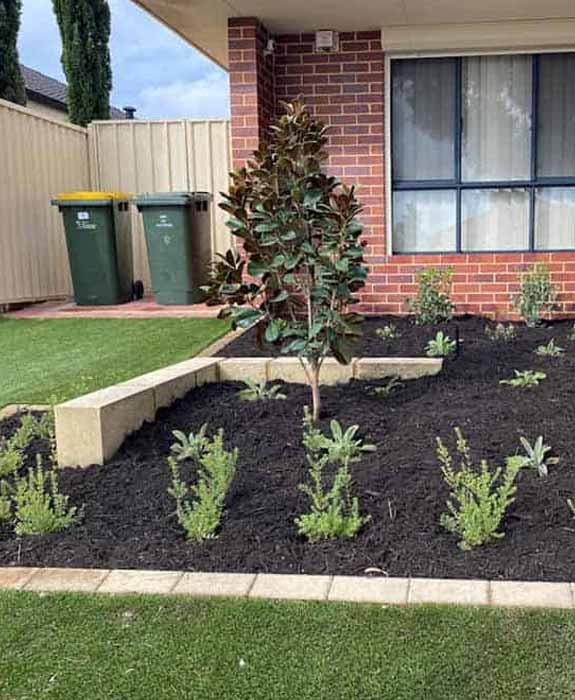
  • Magnolia ‘Little Gem’
  • Standard lilly pilly and standard bay
  • Japanese maple
  • Stone fruit: plum, nectarine, peach, apricot
  • Saplings and self-sown volunteers that have come up where you don’t want them

What we don’t take on, and why

We don’t do large trees. No climbing, no ropes, no elevated work platforms, no chainsaw work at height.

That rules out the big Perth trees: jarrah, marri, tuart, lemon-scented gum, jacaranda, Norfolk Island pine, plane tree, mature peppermint, and anything else that needs a qualified arborist with the gear and the tickets to do it safely.

Large tree work also comes with paperwork. Depending on the tree, the property and the local council, you may need approval, and in a lot of cases that means a written report from a qualified consulting arborist assessing the tree’s health, structure and significance before anything happens. That’s a specialist job, and we’re not going to pretend otherwise.

Street and verge trees We also won’t touch:

  • Street and verge trees
    They belong to your local council. Pruning or removing one without permission can land you with a fine. Call the council, they’ll usually handle it.
  • Anything within three metres of powerlines
    Working near overhead lines in WA is tightly controlled and restricted to people with the right accreditation. If your branches are anywhere near the lines, contact Western Power. Do not get up there yourself with a pole saw.
  • Trees on a significant tree register, or protected under a planning condition
    Some WA councils keep registers of significant trees, and some properties carry tree retention conditions from a development or subdivision approval.

If you call us out and it turns out to be a bigger job than we take on, we’ll tell you on the spot and point you at someone who can. Costs you nothing and saves you a wasted week.

The small tree work we carry out

Crown thinning
Selectively removing branches through the canopy to let light and air through. Makes a difference under a dense tree where nothing will grow, and lets wind pass through instead of pushing against a solid sail.

Crown lifting
Raising the canopy by removing the lowest branches, so you can get a mower under it, walk down the path, or open up a driveway sight line.

Reduction pruning
Bringing a tree back in size by cutting to a suitable lateral branch, not by chopping stems off at an arbitrary height. Done properly the tree still looks like a tree afterwards.

Deadwooding
Taking out dead, damaged and crossing limbs. Improves the look, and removes the bits most likely to come down in a storm.

Clearance work
Getting branches off the roof, out of the gutters, off the solar panels and away from the neighbour’s fence.

Fruit tree pruning
Shaping for accessible fruit, opening the centre for light and airflow, and keeping the tree at a height you can actually pick from.

Formative pruning
Setting up a young tree’s structure in its first few years, which is the cheapest tree work you will ever pay for and saves a fortune later.

Small tree and sapling removal
Including the stump where it’s manageable.

Storm clean-up
on small trees.

Small Tree Pruning & Removal How we cut, and why it matters

Pruning is one of those jobs where the difference between good and bad isn’t visible for about two years, and then it’s very visible.

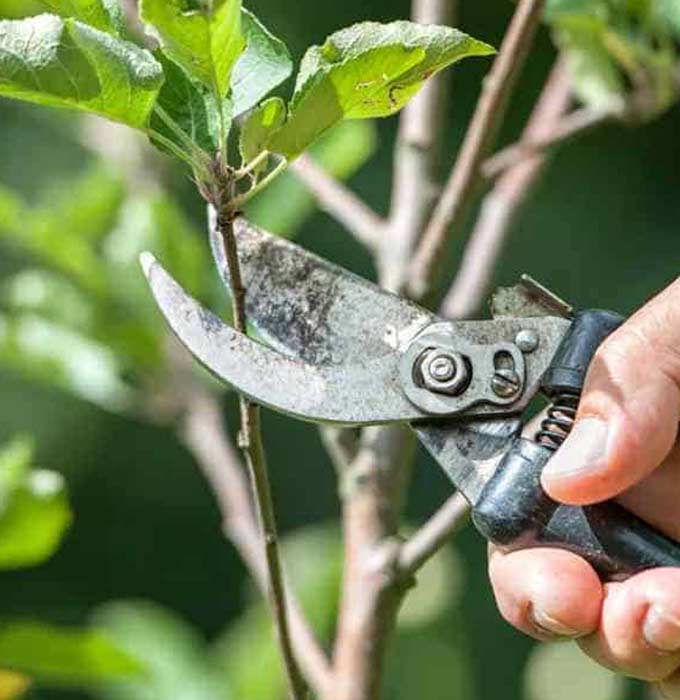
We work to AS 4373 Pruning of Amenity Trees, the Australian Standard, which comes down to a handful of things done consistently:

Cut at the branch collar
There’s a slightly swollen ring where a branch meets the trunk. That collar contains the tissue the tree uses to seal the wound. Cut outside it and the tree closes over the cut in a season or two. Cut flush with the trunk and you’ve removed the collar, so the wound never seals properly and decay walks straight into the trunk.

No stubs
A branch cut halfway along leaves a dead stub the tree can’t seal around. It sits there rotting.

Three cuts on anything with weight in it
Undercut first, then a top cut further out to drop the limb, then the final tidy cut at the collar. Skip the undercut and the falling branch tears a strip of bark down the trunk on its way out.

The one-third rule
When shortening a branch, cut back to a lateral that’s at least a third the diameter of what you’re removing. That lateral then takes over as the new leader. Cut back to nothing and the tree responds with a mess of weak regrowth.

No more than about 20 to 25 per cent of live canopy in one go
Leaves are how the tree feeds itself. Strip too many and it goes into survival mode.

No wound paint
Old practice, long since dropped. Sealing compounds trap moisture and can make decay worse. Trees seal their own wounds when the cut is made in the right place.

Why topping a tree backfires

This is worth understanding before anyone talks you into it.

Cut the top out of a tree and it doesn’t stay short. It panics. It pushes out a dense flush of fast, upright water shoots from just below the cut, and those shoots grow quickly, all from shallow attachment points on the outside of the old wood. They’re structurally weak, which is why storm-damaged branches so often come off trees that were topped years earlier.

So you get a tree that is uglier, taller again within a couple of seasons, more likely to shed limbs, and carrying decay from the untended stubs. Then you pay to have it done again.

Proper reduction pruning costs more on the day and less over ten years.

The best time to prune small trees in Perth

Varies by species, and getting it wrong can cost you a season of flowers or fruit.

Tree type Best window in Perth Why
Citrus After harvest, spring into early summer Light pruning only. Avoid exposing bare limbs to summer sun
Frangipani Spring, as it comes into growth Cuts callus over quickly in warm weather
Deciduous stone fruit (plum, peach, nectarine) Winter dormancy Standard dormant pruning
Around fruit trees and citrus Late summer to early autumn, dry weather Winter cuts invite bacterial canker and dieback. This one catches people out
Olive After harvest, late winter to early spring Open the centre for light
Flowering ornamentals (crepe myrtle, tibouchina, magnolia) Straight after flowering Prune later and you cut off next season’s flower buds
Native small trees (callistemon, melaleuca, grafted gums) After flowering Light tip work keeps them dense
Deadwood and storm damage Any time Doesn’t wait

Small tree pruning across Perth The one to be careful with across the board is peak summer. Removing a chunk of canopy in January exposes bark that has always been shaded, and thin-barked trees like citrus, frangipani and japanese maple will sunburn. Bark splits, the limb dies back, and you’ve caused a problem you were trying to prevent. Unless it’s a safety issue, heavy work waits for cooler weather.

Green waste, and what happens to it

Everything we cut goes with us. Branches, leaf litter, the lot, and we sweep and blow down afterwards.

If you’ve got garden beds that could use it, chipped tree waste makes good mulch once it’s been composted. Worth a conversation while we’re on site, since you’re paying for the material to leave either way.

Small tree pruning across Perth

Our teams work through Perth’s western and northern suburbs daily, including Trigg, Sorrento, Dianella, Churchlands, Kingsley and surrounds. We can handle tree work as a one-off, or roll it into a regular garden maintenance schedule so the citrus and the ornamentals get seen to at the right time of year without you having to think about it.

Get a quote

Send us a photo of the tree and roughly how tall it is, or give Shane a call. We’ll tell you straight away whether it’s one for us or one for a qualified arborist.

Call 0408 479 961

Honest, reliable and friendly service.